
JAMUNA-Project
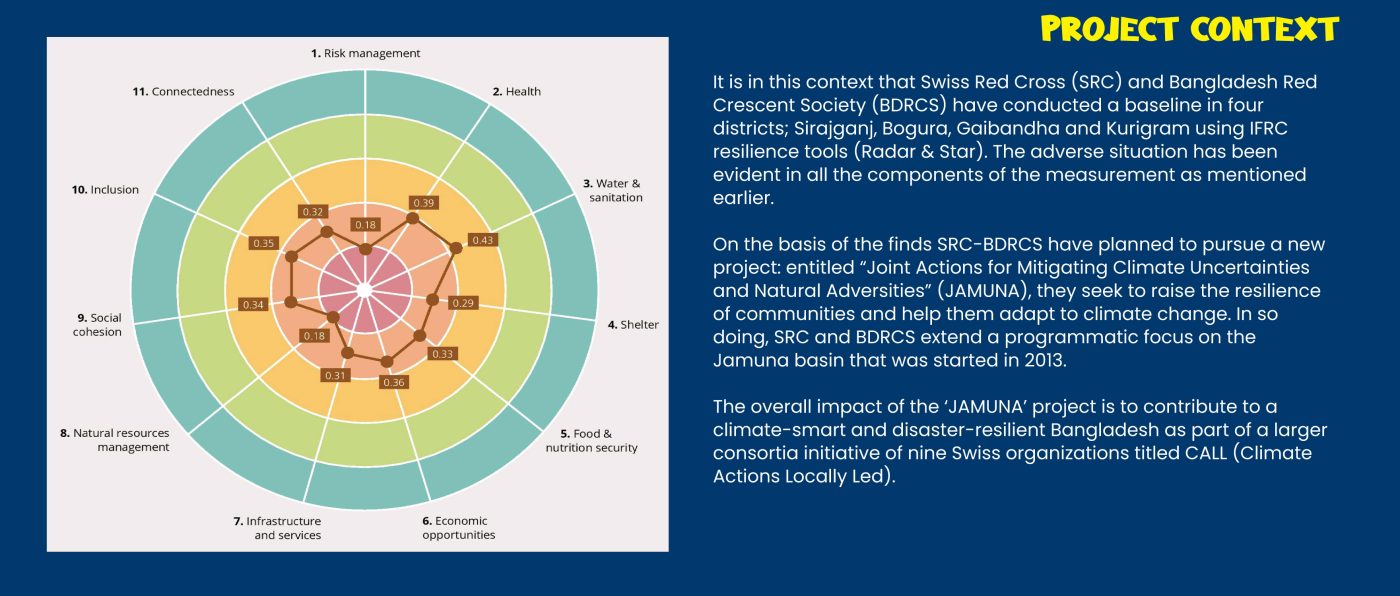
The overall impact of the ‘JAMUNA—Joint Action for Mitigating Climate-induced Uncertainties and Natural Adversities’ project is to contribute to a climate-smart and disaster-resilient Bangladesh as part of a larger consortia initiative of nine Swiss NGOs titled CALL (Climate Action at Local Level).
The programme CALL – Climate Action at Local Level is grounded on the firm belief that long-lasting change needs to be strongly rooted at different levels of intervention and borne by diverse stakeholders of relevance. Finding a common ground and a joint objective to work towards, while at the same time acknowledging differing and, at times, competing interests, can create that enabling environment that is needed to anticipate, respond to, and thrive in the face of the complex and often rapidly evolving challenges of a changing climate. The overall objective and the Theory of Change (ToC) of the CALL programme:
BACKGROUND
Bangladesh, characterized by its riverine landscape and extensive low-lying regions, is particularly susceptible to the impacts of climate change and other hazards. Highlighting the country’s susceptibility, the Global Climate Risk Index 2021 ranks Bangladesh as the seventh most long-term climate-vulnerable nation globally. Studies predict that due to climate change, most climate-related hazards will increase in frequency and/or intensity. The most critical climate change-induced hazards in Bangladesh are rainfall variability, river floods, flash floods, urban floods, sea-level rise, salinity, cyclonic storm surges, droughts, extreme heat waves, extreme cold, riverbank erosion, lightning, landslides, higher sea surface temperature, and ocean acidification.

The Jamuna is the name known to the braided river downstream of the Old Brahmaputra distributary and is one of three large sand-bed rivers that cross the low-lying deltaic floodplain of Bangladesh (Ashworth, 1996). The annual discharge values are around 60’000 m3s-1 which is three times greater than the Mississippi (Singh, Vijay P.; Sharma, Nayan; C. Shekhar; P. Ojha (2004)) and may exceed 100’000 m3s-1 in a 100-year flood (Halcrow et al., 1992). The fourth Intergovernmental Panel on Climate Change (IPCC) Report forecasts for South Asia changing precipitation patterns and increased intensity of monsoonal rainfall due to climate change.
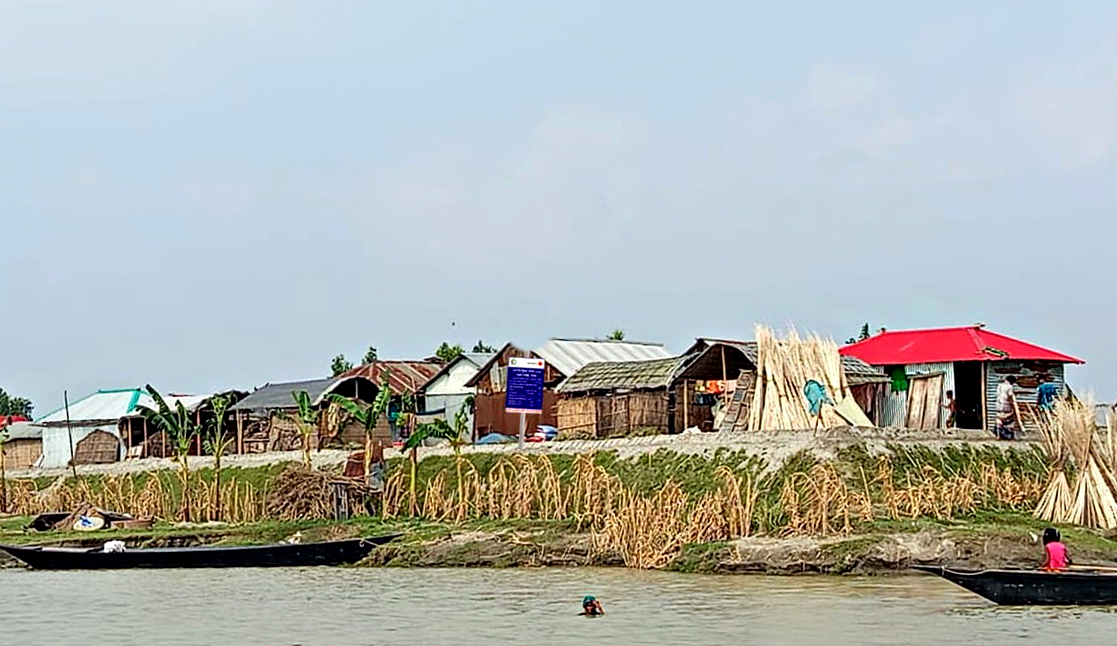
Already the Jamuna has experienced expansion of flow over the years from increased heavy rainfall on its catchment area and runoff from the impact of climate change (global warming) from extreme snowmelts in the Himalayas. The Centre for Environmental and Geographic Information Services (CEGIS) reported that 992 square kilometres of land have been eroded due to riverbank erosion between 1973-2020 in the Jamuna River basin area. Severe bank erosion and rapid rates of bank line retreat along the Jamuna River (Khan and Islam, 2003) is a constant threat to communities. The economy of the people living alongside the Jamuna River is agriculture and fishing based. When heavy rain occurs in the monsoon period, the river Jamuna basin becomes flooded, and the normal life of the inhabitants is severely disrupted, destroying crops and access to land, displacing communities, and perpetuating the cycle of poverty. The districts in the Jamuna River basin are some of the poorest in Bangladesh with a 37% poverty rate much higher than the national average of 25%.
With different climatic events likely to be more frequent and severe in the future, increasingly adverse impacts will jeopardize livelihoods, especially those of the poor, who are mostly dependent on natural resources of this region of Bangladesh which is already announced as a climate stress area.
In facing the challenges of regular natural calamities and climate change, the people of the Jamuna River basin are deprived of development opportunities (Daily Prothom Alo, 23 October 2023). Women’s vulnerability to climate change differs from that of men due to gender inequalities, including reduced access to and control over resources (GED, 2014), limited opportunities for decent work, lower social status (Mitchell et al. 2007), and dependency on men for information (Saroar and Routray, 2012). Bangladesh has a Gender Inequality Index value of 0.537 ranking 133 out of 162 countries.
